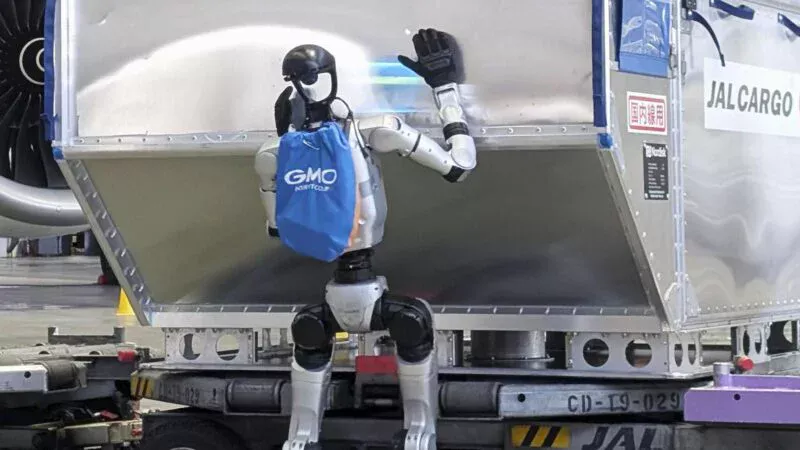
Japan Airlines is accelerating the deployment of humanoid robots into core airport ground operations at Haneda, one of Asia’s busiest hubs, explicitly to offset acute labor shortages. The trial targets repetitive, physically demanding tasks—baggage handling and cabin cleaning—where tourism-driven passenger volumes have surged 3.5% YoY while the domestic workforce shrinks rapidly due to aging demographics and low fertility.
The robots featured in demonstrations are Chinese Unitree H1 models, though JAL has not confirmed direct sourcing; the partnership is with GMO AI & Robotics for integration and feasibility testing. Human oversight remains mandatory in the near term, consistent with analyst views that current dexterity and reasoning capabilities are still limited.
Market reaction was muted but positive: JAL shares rose 2.97% on the announcement day yet remain down 13% YTD, reflecting broader skepticism on execution timelines.
This is not an isolated pilot. Japan’s METI issued formal robotics guidelines in March 2026 explicitly linking AI-physical systems to the birthrate crisis. Prime Minister Sanae Takaichi’s political base reinforces a policy preference for technological substitution over immigration liberalization. Barclays and Counter Research frame this as part of a structural shift: physical AI (AI embodied in machines performing real-world tasks) is moving from laboratory curiosity to operational necessity in logistics, hospitality, and aviation. The addressable market is projected to scale from $2-3 billion today to $1.4 trillion by 2035.
Japan is effectively running a national experiment in humanoid deployment at scale, with aviation as an early proving ground. The trial’s two-year horizon and progressive rollout across Haneda create a real-world dataset that will de-risk the technology faster than pure lab benchmarks. Consensus remains anchored on “not smart enough yet”; the policy and capital signals from Tokyo and Beijing (Unitree’s $614 million IPO) suggest the timeline is compressing to 3-5 years for broader commercial viability, not the 7-10 years many investors still price in.
// Share Your Analysis