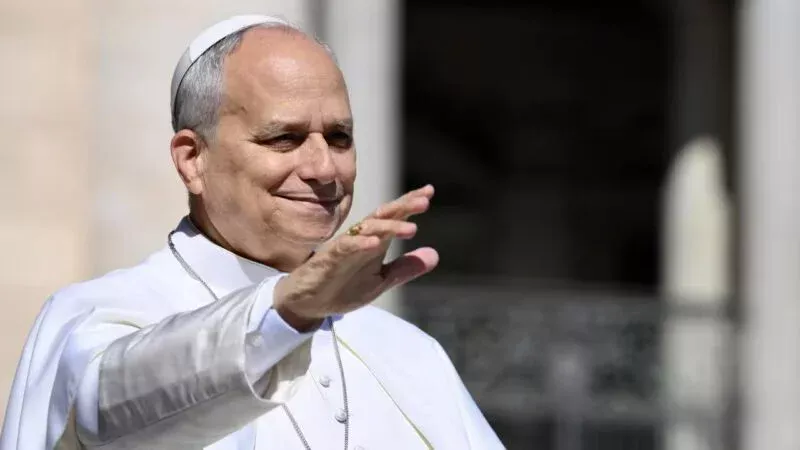
Pope Leo XIV Demands Global AI Regulation: Warns of Autonomous Weapons

May 25, 2026 | Politics | Polyminute News | No comments
Pope Leo XIV Demands Global AI Regulation: Warns of Autonomous Weapons

In his first encyclical “Magnifica Humanitas,” the first U.S. pope calls for slowing AI development, robust oversight, and public data ownership while repudiating the Catholic Church’s “just war” doctrine. He warns that autonomous weapons are slipping beyond human control and that AI risks fueling perpetual conflict.

Pope Leo XIV has issued a major encyclical directly targeting the trajectory of artificial intelligence, framing it as an existential risk to humanity that demands immediate political intervention. Key demands include slowing the pace of AI advancement, implementing independent oversight, protecting workers and children, and preventing private companies from monopolizing AI data ownership. He explicitly calls on AI firms to “cool competition” amid commercial pressures.

A central warning is that certain autonomous weapons systems have advanced “practically beyond any human reach to govern them,” raising the specter of unending war driven by AI-enabled conflict. The pope directly repudiates the centuries-old “just war” theory, stating it has become outdated and is too often used to justify aggression. This is particularly pointed given recent U.S. actions in Iran and statements by Catholic Vice President JD Vance.

The document also addresses supply-chain exploitation in AI hardware (rare earths, child labor) as “new forms of slavery” and includes a formal apology for the Church’s historical role in transatlantic slavery. The launch event included Anthropic co-founder Chris Olah, who acknowledged internal industry tensions between commercial incentives and ethical behavior.

This is one of the most high-profile moral interventions into technology policy in recent history, coming from an institution with 1.4 billion followers and significant soft power across the Global South and Western elites. It blends traditional Catholic social teaching with a forceful stance on 21st-century technological risks.

01

First-Order Effects

Obvious, immediate impacts
  • Increased regulatory scrutiny and potential slowdown in AI deployment timelines, especially in Europe and Catholic-influenced nations.
  • Negative sentiment hit to pure-play AI companies and big tech valuations in the short term due to calls for cooling competition and public data ownership.
  • Strengthened narrative against lethal autonomous weapons systems (LAWS), complicating defense contractor programs.
  • Diplomatic friction between Vatican and Trump administration amplified by implicit criticism of the Iran conflict.
  • Boost to ESG and ethical AI investing narratives, particularly among European and institutional investors.
02

Second-Order Effects

Cross-sector · cross-geography · time-lagged
  • Acceleration of “AI ethics” and “responsible AI” bureaucracy within corporations, raising compliance costs and creating winners among consulting and governance firms.
  • Potential divergence in AI development speed between tightly regulated Western blocs and less constrained players (China, Gulf states, Singapore).
  • Soft power erosion for U.S. tech dominance as Vatican moral authority influences public opinion and younger generations in Latin America, Africa, and parts of Europe.
  • Heightened political risk for defense stocks tied to autonomous systems amid shifting ethical and legal frameworks.
  • Reinforcement of labor and supply-chain due diligence requirements, pressuring semiconductor and hardware supply chains.
03

Alpha Layer — Opportunities

Trades · strategic positioning · business impacts
  • Narrative shift that could fracture the “AI as inevitable progress” consensus, creating multi-year volatility in tech valuations as ethical/regulatory friction becomes structural rather than transient.
  • Opportunity for nation-states and companies positioning themselves as “ethical AI leaders” to capture talent, capital, and regulatory goodwill while laggards face backlash.
  • Long-term challenge to the military-industrial complex’s ability to normalize autonomous lethal systems, potentially creating asymmetric upside in verifiable human-in-the-loop defense technologies.
  • Subtle realignment of Catholic voters and institutions toward more interventionist economic policies and skepticism of unchecked technological capitalism — underpriced by markets.
  • Risk that over-regulation in the West hands strategic AI superiority to authoritarian regimes, creating a classic “unintended consequence” where moral restraint weakens the side most aligned with the pope’s worldview — a classic hedge fund setup where consensus ethics and geopolitical outcomes diverge.

// Share Your Analysis