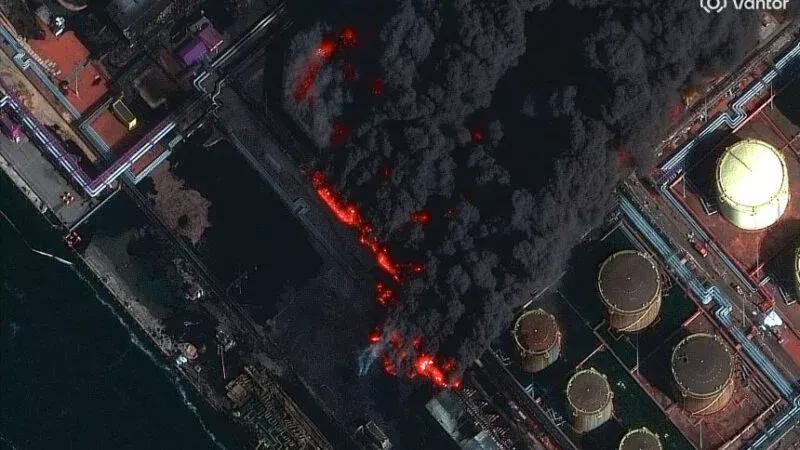
Ukraine Escalates Precision Drone Strikes on Russian Oil Export Terminals and Refineries

Mar 29, 2026 | Geopolitics 🇷🇺 Russia | Polyminute News | No comments
Ukraine Escalates Precision Drone Strikes on Russian Oil Export Terminals and Refineries

Ukrainian forces hit key sites including Ust-Luga (40% capacity loss), Primorsk, Yaroslavl refinery and Saratov in the past week — the 10th major energy strike this month — while Moscow enjoys premium crude pricing and partial US sanctions relief amid Middle East disruptions. Russia eyes gasoline export ban from April 1 to shield domestic supply.

Ukrainian long-range drones have accelerated a summer-started campaign against Russia’s energy backbone, claiming 10 major strikes in March 2026 alone. Confirmed targets: Ust-Luga Baltic terminal (multiple hits, fires, Zelensky states 40% capability remains), nearby Primorsk (ongoing visible fires), Yaroslavl refinery (direct hit, fire, civilian spillover acknowledged) and Saratov Rosneft facility. Geolocated imagery and Russian emergency statements confirm damage to loading stands, tank farms and processing units.

This occurs precisely as Russia captures a revenue windfall. Pre-Middle East conflict, Russian crude traded at a deep discount; now it commands a premium in spots. US Treasury suspension of sanctions on Russian crude already at sea has eased flows further. Analysts estimate oil-related budget revenue (≥1/3 of total) may have doubled in the past month. Moscow is now discussing re-imposition of a gasoline export ban effective April 1 — previously lifted in January — citing domestic market strain from “unscheduled refinery maintenance” and the port fires, per TASS and Kommersant.

Zelensky explicitly frames the strikes as retaliation for Russian winter attacks on Ukrainian power infrastructure and criticizes the sanctions relief as enabling Russian-Iranian coordination. The net effect is asymmetric: physical disruption to export infrastructure versus a price-driven cash surge for the Kremlin. Immediate production/export losses are real but appear partially offset by elevated margins and rerouting potential. Market participants must now price both constrained Russian barrels and Russia’s improved fiscal breathing room to sustain the war.

01

First-Order Effects

Obvious, immediate impacts
  • Russian Baltic export capacity (Ust-Luga + Primorsk) curtailed by ~40% at key terminal, tightening near-term seaborne crude and product availability.
  • Global oil price volatility spikes as traders reprice Russian supply risk premium; prompt Brent/WTI contango likely widens.
  • Russian gasoline export ban from April 1 locks barrels domestically, supporting local pump prices but removing ~200-300 kbpd from global product market.
  • Short-term revenue windfall for Kremlin (doubled oil earnings) cushions any physical losses and funds immediate military procurement.
  • Ruble strengthens on higher export receipts while European diesel and jet fuel cracks widen on lost Russian product flows.
02

Second-Order Effects

Cross-sector · cross-geography · time-lagged
  • European refiners face higher feedstock costs and product imports, accelerating substitution toward US/Middle East barrels and lifting Atlantic Basin tanker rates.
  • Russian refiners divert crude to domestic stocks to avoid export ban penalties, creating inland logistical bottlenecks and potential regional fuel shortages.
  • Middle East oil producers (Saudi, UAE) quietly gain market share as Russian barrels lose reliability, strengthening OPEC+ cohesion in the short run.
  • Ukrainian drone success validates low-cost asymmetric warfare model, prompting NATO allies to accelerate long-range munition deliveries.
  • Insurance and freight rates for Russian-origin cargoes jump, raising effective cost of shadow-fleet operations and compressing Russian netback margins.
03

Alpha Layer — Opportunities

Trades · strategic positioning · business impacts
  • Russia’s oil infrastructure becomes permanently more fragile and capex-heavy, forcing diversion of war-budget resources into redundant pipelines/ports — consensus underprices this slow bleed.
  • Sanctions relief proves self-defeating: higher prices + partial carve-outs fund the adversary while Ukrainian strikes continue, eroding US/EU leverage narrative.
  • Global energy security re-pricing favors non-Russian, non-OPEC+ supply chains; long-dated LNG and Canadian heavy oil contracts become structurally cheaper hedges.
  • Hybrid-war playbook shifts: drone saturation tactics now credible against any energy exporter, creating asymmetric upside for defense-tech pure plays (loitering munitions, EW) and downside for traditional oil majors with exposed upstream.
  • Market is likely mispricing Russia’s fiscal resilience — windfall may extend Kremlin runway 12-18 months longer than expected, delaying any negotiated settlement and widening the opportunity for short Russian sovereign credit / long Ukrainian reconstruction plays.

// Share Your Analysis