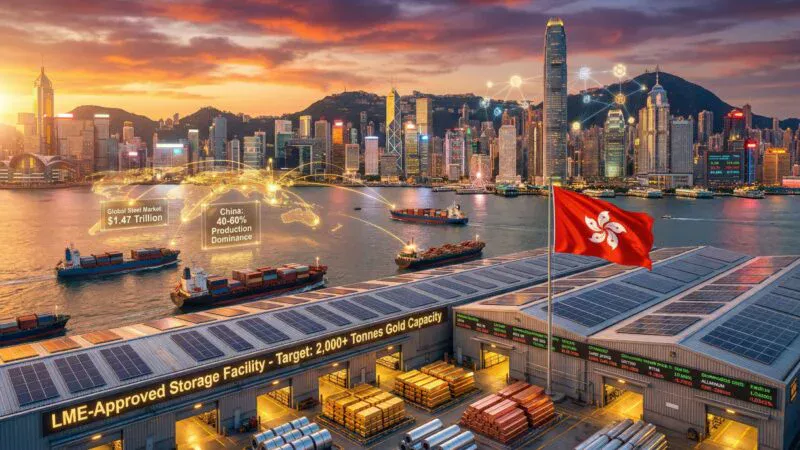
Hong Kong Halves Commodity Trading Tax to 8.25%

Apr 17, 2026 | Commodities 🇭🇰 Hong Kong | Polyminute News | No comments
Hong Kong Halves Commodity Trading Tax to 8.25%

Hong Kong is slashing profits tax to 8.25% for qualifying physical commodity traders in mining, metals, oil and agri products. The move, announced amid Middle East disruptions and soaring bunker costs, aims to lure global desks from Singapore, Geneva and London, directly lift shipping volumes at its 13.7 million TEU port, and monetise its trade-finance, arbitration and “one country, two systems” edge.

Hong Kong is launching a concessionary 8.25% profits tax regime (halved from 16.5%) exclusively for physical commodity trading profits. The policy explicitly targets mining commodities and is framed as a maritime multiplier: more trading desks = higher vessel call volumes and cargo throughput.

The timing is not coincidental. Middle East conflict has closed key chokepoints, forced rerouting, and spiked bunker prices, compressing shipping margins across Asia. Hong Kong’s port, while still one of the world’s busiest, has lost share to mainland terminals for a decade; officials see the tax break as the cheapest lever to reverse that trend.

Hong Kong’s current commodity trading footprint is “relatively limited” per the 2025 Financial Services Development Council report, despite world-class supporting infrastructure in trade finance, legal arbitration and shipping services. It now offers a cleaner, more predictable rate than Singapore’s 5–10% tiered Global Trader Programme, Geneva’s 14–15% effective rate, or London’s 25%. The blanket 8.25% concession removes the need for case-by-case negotiations that Singapore still requires.

Crucially, the pitch is geopolitical as much as fiscal: Hong Kong is positioning itself as the stable Asian base with direct mainland connectivity but separate legal and tax sovereignty. In a world of friend-shoring and supply-chain de-risking, this hybrid status is being sold as a feature, not a bug.

The policy is narrow (physical commodities only) but high-signal: it signals Beijing’s willingness to let Hong Kong compete aggressively on tax for strategic sectors without waiting for broader corporate-tax reform.

01

First-Order Effects

Obvious, immediate impacts
  • Qualifying physical commodity traders immediately cut their Hong Kong tax bill by 50%, improving post-tax ROE and accelerating relocation/expansion decisions.
  • Global trading houses accelerate headcount and desk build-out in Hong Kong, directly lifting local office occupancy and high-end residential demand.
  • Shipping activity at Hong Kong port rises as incremental physical trades generate more vessel fixtures and container movements.
  • Competitive pressure on Singapore intensifies; desks already evaluating GTP renewals now have a simpler 8.25% alternative on the table.
  • Short-term positive sentiment spike in Hong Kong-listed shipping, port operators and trade-finance names.
02

Second-Order Effects

Cross-sector · cross-geography · time-lagged
  • Surge in demand for Hong Kong-based trade finance, marine insurance, and arbitration services as new desks route documentation and risk through the city.
  • Mainland Chinese commodity buyers and state-owned enterprises gain easier access to international pricing and hedging desks physically located in Hong Kong rather than Singapore.
  • Singapore’s ecosystem faces talent and capital leakage; some mid-tier traders may split books between the two hubs to optimise tax and regulatory arbitrage.
  • Hong Kong real-estate and legal sectors see second-round revenue uplift from increased corporate structuring and dispute-resolution work tied to new commodity flows.
  • Behavioral shift: risk-averse Western traders diversify away from pure Singapore concentration risk by opening parallel Hong Kong books.
03

Alpha Layer — Opportunities

Trades · strategic positioning · business impacts
  • Hong Kong evolves from supporting player to credible third global commodity trading pole, fragmenting liquidity pools and creating new basis and calendar-spread arbitrage opportunities between HK, SG and Geneva books.
  • “One country, two systems” narrative gets a market-validated boost; consensus view that Hong Kong is too politically tainted for Western trading desks is tested and potentially disproved.
  • Accelerated shift of certain physical commodity flows (especially those linked to China demand) from European to Asian hubs, shortening supply chains and reducing exposure to Red Sea volatility.
  • Underpriced structural winner: Hong Kong dollar funding costs and local shipping/logistics equities; market still prices the port’s decline as secular when policy is explicitly reversing it.
  • Consensus likely underestimates scale: Singapore’s response lag + Hong Kong’s lower compliance friction could trigger 15–20% market-share migration within 24–36 months, creating asymmetric long HK / short SG positioning in maritime and financial-services indices.

// Share Your Analysis