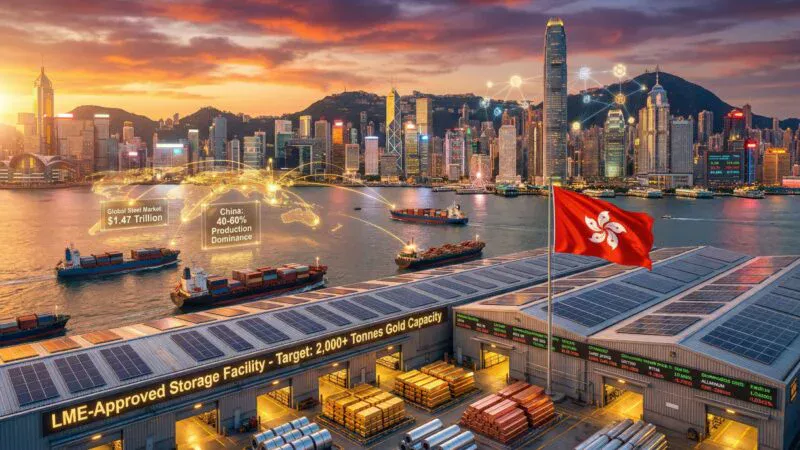
Hong Kong is launching a concessionary 8.25% profits tax regime (halved from 16.5%) exclusively for physical commodity trading profits. The policy explicitly targets mining commodities and is framed as a maritime multiplier: more trading desks = higher vessel call volumes and cargo throughput.
The timing is not coincidental. Middle East conflict has closed key chokepoints, forced rerouting, and spiked bunker prices, compressing shipping margins across Asia. Hong Kong’s port, while still one of the world’s busiest, has lost share to mainland terminals for a decade; officials see the tax break as the cheapest lever to reverse that trend.
Hong Kong’s current commodity trading footprint is “relatively limited” per the 2025 Financial Services Development Council report, despite world-class supporting infrastructure in trade finance, legal arbitration and shipping services. It now offers a cleaner, more predictable rate than Singapore’s 5–10% tiered Global Trader Programme, Geneva’s 14–15% effective rate, or London’s 25%. The blanket 8.25% concession removes the need for case-by-case negotiations that Singapore still requires.
Crucially, the pitch is geopolitical as much as fiscal: Hong Kong is positioning itself as the stable Asian base with direct mainland connectivity but separate legal and tax sovereignty. In a world of friend-shoring and supply-chain de-risking, this hybrid status is being sold as a feature, not a bug.
The policy is narrow (physical commodities only) but high-signal: it signals Beijing’s willingness to let Hong Kong compete aggressively on tax for strategic sectors without waiting for broader corporate-tax reform.
// Share Your Analysis