US Troop Buildup Exceeds 50,000 in Middle East

Mar 30, 2026 | Geopolitics 🇮🇷 Iran | Polyminute News | No comments
US Troop Buildup Exceeds 50,000 in Middle East

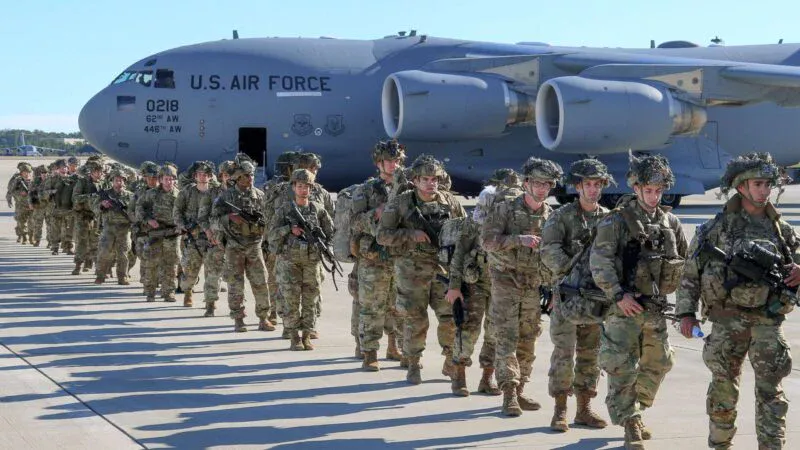
The U.S. has surged its military presence in the Middle East to over 50,000 troops — 10,000 above normal — with the arrival of 2,500 Marines and 2,500 sailors. The buildup supports President Trump’s options in the Iran war, including possible seizure of Kharg Island to reopen the Strait of Hormuz.

US has now deployed 2,500 Marines from the 31st MEU plus 2,500 sailors aboard USS Tripoli, pushing total American forces in the region above 50,000 — 10,000 above the pre-escalation baseline of ~40,000. This occurs one month into Trump’s war with Iran, with the Strait of Hormuz (20% of global oil transit) effectively closed by Iranian retaliation. Pentagon has also surged 2,000 soldiers from the 82nd Airborne, positioned for potential strikes on Kharg Island, Iran’s primary oil export terminal. USS Gerald Ford carrier has exited theater due to mechanical failures. Military analysts note the force is far too small for sustained land operations against a country of 93 million with Iran’s terrain and arsenal.

The deployment keeps options open for limited ground action to break the Hormuz blockade while signaling escalation without committing to full invasion. Consensus views this as tactical posturing; the data says otherwise: the specific mix of Marines, airborne, and amphibious assets is optimized for rapid seizure of chokepoint infrastructure, not occupation.

01

First-Order Effects

Obvious, immediate impacts
  • Oil risk premium surges immediately; Brent and WTI expected to gap 8-15% higher on confirmed Hormuz closure and seizure rhetoric.
  • Energy equities (XLE, integrated majors with Gulf exposure) outperform broader indices by 3-5% in first 48 hours.
  • Defense primes tied to amphibious and airborne platforms (HII, LMT, GD) see targeted buying on deployment confirmation.
  • Persian Gulf shipping and insurance rates spike 200-400% within days.
  • USD and gold bid as classic geopolitical safe-haven flows accelerate.
02

Second-Order Effects

Cross-sector · cross-geography · time-lagged
  • GCC producers quietly ramp output to offset Iranian barrels, widening OPEC+ quota fractures and pressuring Saudi fiscal breakeven.
  • European and Asian spot LNG and coal markets tighten as power generators hedge oil-to-gas switching costs.
  • US-China trade tensions re-ignite as Beijing accuses Washington of weaponizing energy chokepoints, accelerating yuan oil settlement deals.
  • Airline and shipping equities sell off on fuel-cost volatility while tanker stocks (EURN, FRO) outperform.
  • Retail investor sentiment shifts toward commodity ETFs; gold and copper see retail inflows disproportionate to macro backdrop.
03

Alpha Layer — Opportunities

Trades · strategic positioning · business impacts
  • Market is underpricing Trump’s willingness to accept short-term oil shock for long-term leverage over Iran’s nuclear program; consensus assumes “limited strike = limited price impact” but history (1980s tanker war) shows chokepoint seizures create multi-quarter premiums.
  • Accelerated de-dollarization in energy trade as BRICS accelerate non-USD settlement infrastructure to bypass Hormuz-related US leverage.
  • US shale and Permian producers become marginal global swing suppliers, triggering capex boom and M&A wave in US upstream that consensus currently dismisses as “already priced.”
  • Asymmetric long volatility in oil (long-dated calls or strangles) offers superior risk/reward versus consensus “buy the dip” equity stance; the 50k-troop signal is a credible threat that forces Iran to either escalate asymmetrically or negotiate from weakness.
  • Long-term: permanent upward rerating of strategic petroleum reserve importance and domestic energy security premia, creating structural tailwinds for US LNG export infrastructure and nuclear restart narratives that the market has largely ignored.

// Share Your Analysis