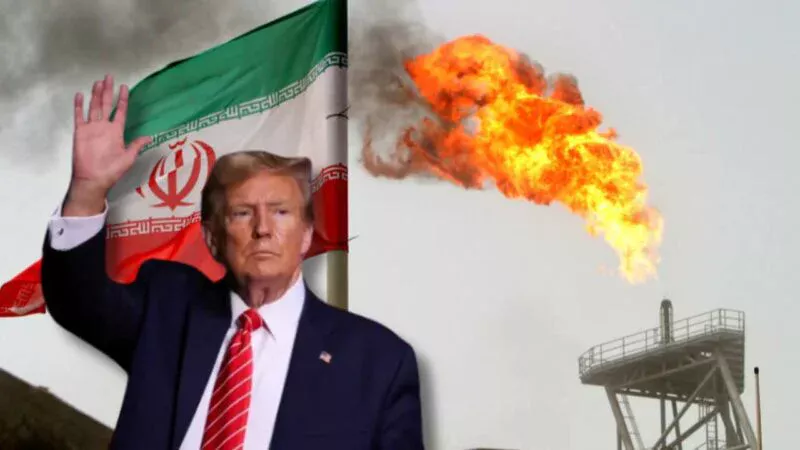
Trump Eyes Seizing Iran Oil: Geopolitical Power Play to Crush China

Apr 7, 2026 | Macro 🇮🇷 Iran | Polyminute News | No comments
Trump Eyes Seizing Iran Oil: Geopolitical Power Play to Crush China

Donald Trump is openly floating the seizure of Iran’s oil assets to cement U.S. energy supremacy and starve China of Iranian crude. The move reflects his core doctrine that oil equals geopolitical leverage, yet it collides with massive military, legal, and domestic-political barriers. No formal plan exists—pure signal for now amid volatile energy markets and shifting global power balances.

Trump has publicly tested the idea of U.S. control over Iranian oil infrastructure as a dual-purpose weapon: locking in American energy dominance while surgically restricting Beijing’s access to Iranian barrels. The logic is vintage Trump—commodity control is power projection. By choking Iran’s export flows (heavily tilted toward China), Washington could simultaneously tighten the screws on Beijing’s refining system and supply-chain resilience without a direct trade-war escalation.

The proposal is still embryonic. No operational blueprint has surfaced, and Trump himself flagged American fatigue with Middle East quagmires. Execution would demand sustained military presence, invite international legal challenges, and risk domestic backlash. Yet the mere articulation serves as high-decibel signaling: it raises the shadow price of Iranian oil, forces China to reveal its true vulnerability, and recalibrates expectations around future U.S. energy statecraft.

Critically, Beijing has spent years de-risking exactly this scenario. Strategic crude reserves, ramped-up domestic output, and aggressive renewable build-out have materially lowered its exposure to any single Persian Gulf chokepoint. Markets that treat this as a binary “seize or not” event are missing the asymmetric preparation gap: U.S. upside is capped by political constraints; China’s downside is already partially hedged.

In macro terms, the story is less about imminent barrels disruption and more about narrative repositioning. It reframes U.S. energy policy from “independence” to “offensive leverage,” injects fresh volatility into the term structure of oil, and forces capital allocators to reprice long-term geopolitical risk premia across energy, shipping, and China-exposed industrials. Until concrete steps emerge, this remains a high-signal probe rather than policy—priced by markets at the margin but under-analyzed for its second- and third-derivative effects on global capital flows.

01

First-Order Effects

Obvious, immediate impacts
  • Oil volatility spikes immediately on headline risk; front-month Brent/WTI contango steepens as traders hedge potential Iranian supply shock.
  • U.S. upstream and oil-services equities rally on “energy dominance” narrative, widening the spread versus international majors.
  • Diplomatic rhetoric between Washington, Tehran, and Beijing escalates, lifting near-term risk premium in Persian Gulf shipping and insurance rates.
  • Defense-contractor names with Iran theater exposure see sentiment-driven buying on speculation of renewed military posture.
02

Second-Order Effects

Cross-sector · cross-geography · time-lagged
  • Asian refiners accelerate diversification away from Iranian barrels toward Russian, Saudi, and Brazilian grades, tightening Atlantic Basin crude balances.
  • China doubles down on Belt & Road energy infrastructure and LNG import deals, accelerating yuan-denominated commodity settlements.
  • Global shipping and tanker equities bifurcate: Iranian-linked routes face higher insurance costs while non-Iran routes see capacity reallocation.
  • OPEC+ cohesion fractures or hardens depending on Saudi/Russian response, creating tactical trading opportunities in the forward curve.
03

Alpha Layer — Opportunities

Trades · strategic positioning · business impacts
  • Long-term erosion of the petrodollar recycling mechanism if Washington is perceived to weaponize oil ownership, quietly accelerating BRICS+ de-dollarization trades that consensus still dismisses as fringe.
  • Narrative pivot from U.S. “energy independence” to “energy imperialism” forces European and Asian allies to reprice security-of-supply premia, creating structural bid for non-U.S. LNG and nuclear assets.
  • China’s pre-positioned resilience (reserves + renewables) is systematically underpriced by markets; long-dated China energy-equity and critical-minerals baskets offer asymmetric convexity if the plan fizzles.
  • U.S. political capital spent on an unenforceable oil seizure could crowd out more effective non-kinetic levers (tariffs, tech export controls), handing Beijing a strategic communications win and opening tactical shorts in over-hyped U.S. defense names once reality sets in.
  • Market currently prices this as transient rhetoric; the real alpha sits in the multi-year regime shift toward commodity nationalism, favoring owners of hard assets in politically stable jurisdictions over pure financial claims.

// Share Your Analysis