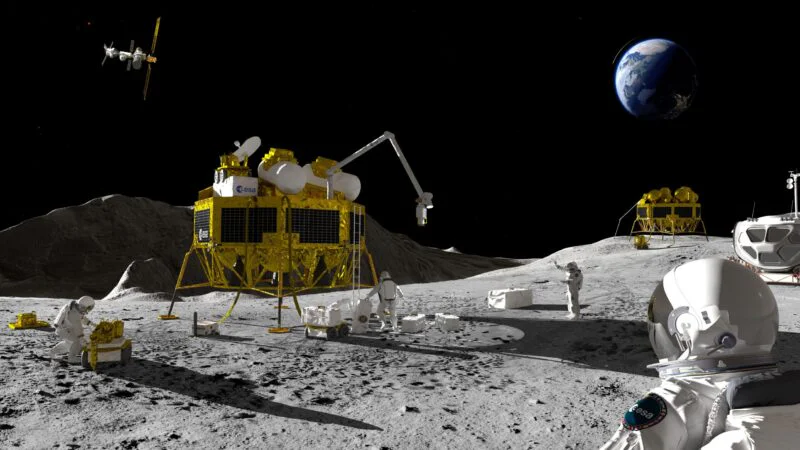
Voyager Technologies CEO Dylan Taylor stated at CNBC CONVERGE LIVE that humans will reach the Moon by end-2020s via inflatable habitats with life support, scaling to visible lunar settlements by 2032-33. SpaceX is now explicitly building toward a “self-growing city on the Moon” in under 10 years; Blue Origin has paused suborbital tourism to prioritize sustained lunar presence.
US policy tailwinds are decisive: President Trump’s April 3 request for $1.5 trillion defense spending and the April 21 Air Force/Space Force FY2027 budget ask exceeding $300 billion create an explicit “windfall” for commercial space. Voyager, public since June 2025 and developer of the Starlab successor to the retiring 2030 ISS, is positioned as a direct beneficiary.
Sector fundamentals already validate the shift: Low Earth Orbit attracted $45 billion in 2025 (up from $25 billion in 2024). Data-center capabilities are already operating in space today for AI inference, with full orbital data centers expected within five years despite thermal challenges. The Commercial Space Federation confirms the US remains “by far” the global leader.
Artemis II’s recent success (first Canadian lunar flyby) has reinforced political and public momentum, with former PM Justin Trudeau framing lunar/Mars progress as essential narrative counter to “celebration of ignorance.” Consensus still treats lunar industrialization as a 2040s story; the synchronized corporate timelines, budget requests, and private capital acceleration indicate the market is underpricing the 2027-2030 execution window.
// Share Your Analysis