
Democrats Smash Record 63% Odds for 2028 Presidential Election

Apr 16, 2026 | Politics 🇺🇸 United States | Polyminute News | No comments
Democrats Smash Record 63% Odds for 2028 Presidential Election

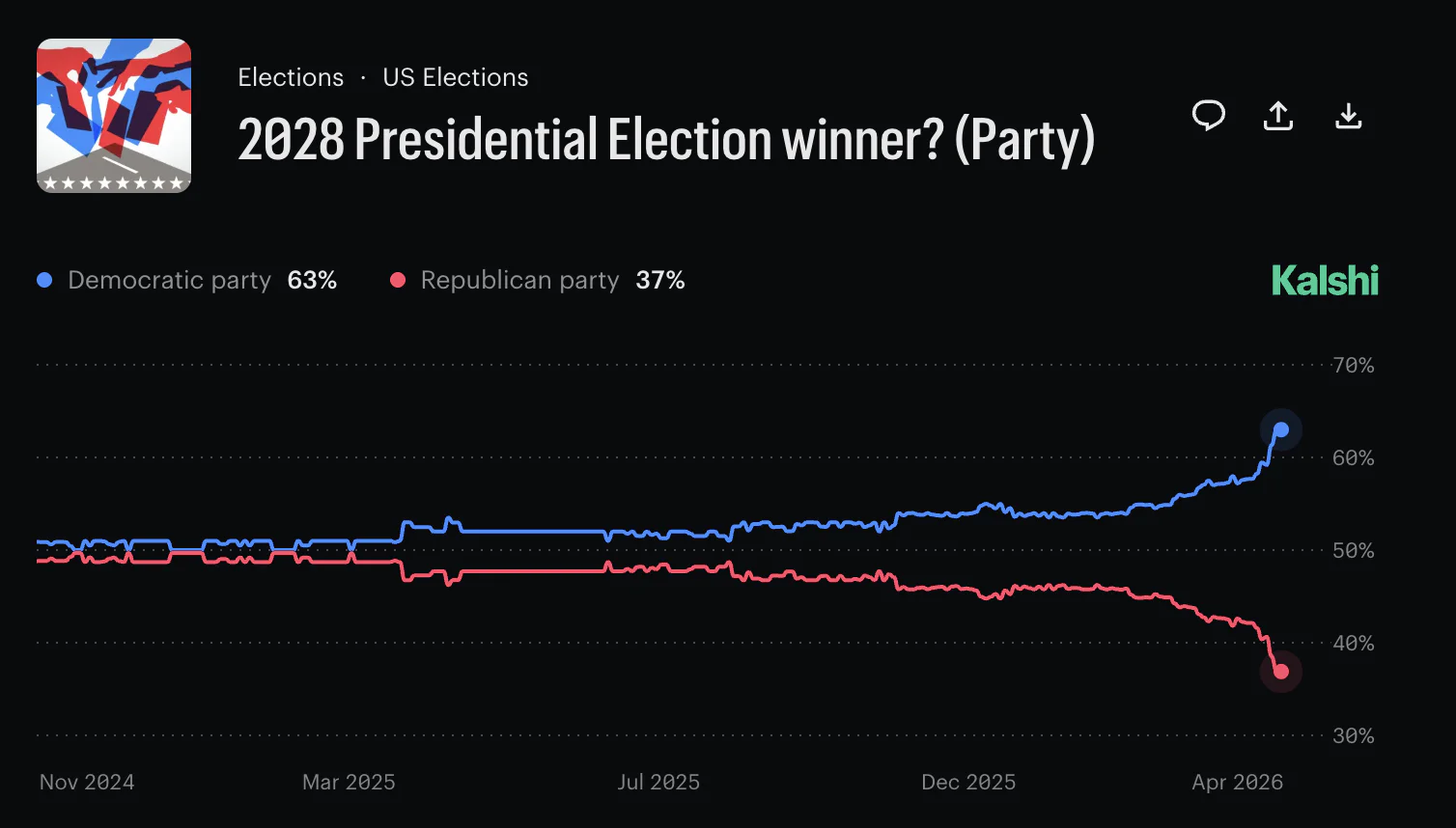
Prediction markets just repriced the 2028 presidential race in real time: Democratic Party odds hit an all-time high of 63% while Republican odds fell to 37%. The Kalshi chart shows a sharp, sustained blue-line surge on $357k volume, confirming a decisive shift in crowd-sourced probability well ahead of traditional polling.

Kalshi, a CFTC-regulated prediction market, now prices a Democratic victory in the 2028 presidential election at 63% versus 37% for Republicans — the highest Democratic reading on record. The platform’s multi-month chart (ALL timeframe) reveals a clear inflection: steady Democratic gains followed by a steep vertical spike in recent sessions, mirrored by an accelerated Republican decline. Volume of $357,844 reflects serious capital conviction rather than retail noise.

Prediction markets have consistently outperformed polls and pundits in recent U.S. cycles by aggregating marginal information faster. This move therefore represents the highest-signal forward-looking indicator currently available on 2028 regime risk. It is not a random fluctuation; the scale and speed of the repricing imply participants are internalizing macro, legislative, or scandal-driven developments that tilt the playing field toward Democrats two years out. For capital allocators, this is the earliest actionable political-beta signal for the next presidential cycle.
01

First-Order Effects

Obvious, immediate impacts
  • Political-risk premium in equities, rates, and FX immediately reprices toward Democratic policy expectations (higher corporate taxes, expanded green subsidies, tighter regulation).
  • Green-energy, EV, renewable, and healthcare stocks receive instant sentiment tailwind; traditional energy and certain defense names face immediate pressure.
  • Election-futures and related derivatives across Kalshi, Polymarket, and offshore venues adjust in lockstep, tightening spreads and forcing delta-hedging flows.
  • Short-term volatility premium rises in S&P 500 sectors most exposed to fiscal and regulatory regime change.
02

Second-Order Effects

Cross-sector · cross-geography · time-lagged
  • 2026 midterm fundraising and turnout models shift in Democrats’ favor, raising probability of narrowed or flipped congressional majorities well before 2028 ballots are cast.
  • Corporate capex and M&A calendars accelerate or defer based on anticipated 2029 tax and spending outlook, creating sector-specific investment pull-forwards or push-backs.
  • Foreign governments and central banks recalibrate U.S. policy assumptions on trade, NATO burden-sharing, and China containment, feeding into currency and commodity positioning.
  • Retail and systematic flows rotate into “blue-wave” thematic ETFs and away from value/energy, amplifying sector rotation beyond headline beta.
03

Alpha Layer — Opportunities

Trades · strategic positioning · business impacts
  • Consensus narrative that “2028 remains too distant to trade” is now demonstrably wrong; Kalshi’s liquid, real-time signal forces professional investors to shorten their political forecasting horizon, creating alpha for those who reposition earliest.
  • Underpricing of a potential Democratic policy trifecta (White House + Senate + House) offers asymmetric upside in ESG-tilted industrials, biotech, and clean-tech supply chains where current pricing still embeds 2024-era GOP tailwinds.
  • Long-term capital allocation in infrastructure, energy transition, and tax-advantaged vehicles begins to embed 2028 probabilities today, opening structural opportunities in private credit and project finance tied to expected subsidy regimes.
  • Prediction-market credibility as a leading macro indicator strengthens, accelerating institutional adoption and creating a new feedback loop between crowd-sourced odds and mainstream financial modeling.

// Share Your Analysis