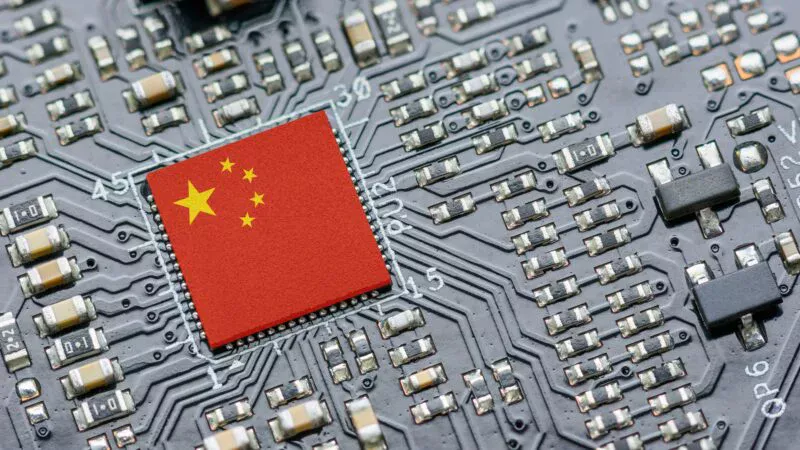
China Chip Revenue Hits Record Highs on AI Boom and US Curbs

Apr 3, 2026 | Tech 🇨🇳 China | Polyminute News | No comments
China Chip Revenue Hits Record Highs on AI Boom and US Curbs

Chinese semiconductor firms including SMIC, Hua Hong, Moore Threads and CXMT posted record 2025 revenues driven by explosive AI compute demand, memory shortages and US export bans that accelerated Beijing’s domestic substitution push. SMIC revenue rose 16% to $9.3B with 2026 guidance above $11B; CXMT memory sales jumped 130% to ~$8B. Even lagging tech is winning in a captive market—signaling sanctions are backfiring faster than consensus expects.

Chinese chipmakers delivered record 2025 revenues across logic, foundry and memory segments, powered by three mutually reinforcing drivers: surging domestic AI infrastructure demand, global memory shortages that spiked HBM pricing, and US export controls that turned import substitution into “rocket fuel” for the entire sector (Albright Stonebridge’s Paul Triolo).

MIC posted $9.3B revenue (+16% YoY) and guided >$11B for 2026. Hua Hong delivered record Q4 sales with flat-to-up guidance. Moore Threads, the domestic GPU hopeful targeting Nvidia’s China market, forecast 231-247% YoY growth. CXMT, China’s leading memory player, saw revenue explode 130% to approximately $8B, capturing share in restricted high-bandwidth memory after HBM exports were cut off.

The mechanism is straightforward yet under-appreciated: US curbs on advanced Nvidia GPUs and HBM created a domestic “compute gap” that Huawei, Baidu and other hyperscalers are filling with locally sourced alternatives—even when performance lags. “Good enough” domestic silicon is now the default procurement choice inside China. Memory shortages provided additional tailwinds, allowing CXMT to monetize even HBM2/HBM2e generations that leading Korean and US players abandoned years ago.

Critically, the memory ramp is not isolated. Triolo notes that every new memory fab in China now functions as an unintended incubator for advanced process technology post-2022 US controls—skills that will migrate to logic and GPU nodes. Yet structural ceilings remain: SMIC and Hua Hong still cannot scale leading-edge nodes without EUV lithography denied by Dutch export rules. Overcapacity risk in mature nodes is real if domestic demand does not keep pace with new supply.

Net result: US policy designed to slow China has instead turbocharged revenue momentum and accelerated supply-chain decoupling in a protected home market of unprecedented scale. Consensus that sanctions would cripple China’s AI ambitions is being disproven in real time by the P&L.

01

First-Order Effects

Obvious, immediate impacts
  • Chinese chipmakers delivered record 2025 revenues across logic, foundry and memory segments, powered by three mutually reinforcing drivers: surging domestic AI infrastructure demand, global memory shortages that spiked HBM pricing, and US export controls that turned import substitution into “rocket fuel” for the entire sector (Albright Stonebridge’s Paul Triolo).
  • SMIC posted $9.3B revenue (+16% YoY) and guided >$11B for 2026. Hua Hong delivered record Q4 sales with flat-to-up guidance. Moore Threads, the domestic GPU hopeful targeting Nvidia’s China market, forecast 231-247% YoY growth. CXMT, China’s leading memory player, saw revenue explode 130% to approximately $8B, capturing share in restricted high-bandwidth memory after HBM exports were cut off.
  • The mechanism is straightforward yet under-appreciated: US curbs on advanced Nvidia GPUs and HBM created a domestic “compute gap” that Huawei, Baidu and other hyperscalers are filling with locally sourced alternatives—even when performance lags. “Good enough” domestic silicon is now the default procurement choice inside China. Memory shortages provided additional tailwinds, allowing CXMT to monetize even HBM2/HBM2e generations that leading Korean and US players abandoned years ago.
  • Critically, the memory ramp is not isolated. Triolo notes that every new memory fab in China now functions as an unintended incubator for advanced process technology post-2022 US controls—skills that will migrate to logic and GPU nodes. Yet structural ceilings remain: SMIC and Hua Hong still cannot scale leading-edge nodes without EUV lithography denied by Dutch export rules. Overcapacity risk in mature nodes is real if domestic demand does not keep pace with new supply.
  • Net result: US policy designed to slow China has instead turbocharged revenue momentum and accelerated supply-chain decoupling in a protected home market of unprecedented scale. Consensus that sanctions would cripple China’s AI ambitions is being disproven in real time by the P&L.
02

Second-Order Effects

Cross-sector · cross-geography · time-lagged
  • “Delete America” procurement cascades from hardware into software ecosystems, accelerating local CUDA alternatives and fragmenting AI developer tools.
  • Intensified domestic talent war and R&D capex as Chinese firms chase value-chain ascent, tightening global semiconductor engineering supply.
  • Margin compression for Samsung, SK Hynix and Micron in non-China markets as excess Chinese capacity eventually leaks globally.
  • Cost-competitiveness boost for China’s EV supply chain via cheaper domestic power semiconductors and controllers.
  • Entrenched behavioral shift: Chinese OEMs now default to local silicon even at 20-30% performance discount, locking in market bifurcation.
03

Alpha Layer — Opportunities

Trades · strategic positioning · business impacts
  • Parallel semiconductor ecosystem now forming at speed; consensus vastly underprices spillover from memory-fab learning curves into logic/GPU nodes by 2028-30.
  • Global overcapacity in legacy nodes triggers price wars that disproportionately damage non-Chinese mature-node producers while China protects its home market.
  • Narrative pivot from “sanctions cripple China” to “sanctions catalyze China’s tech sovereignty,” likely prompting US policy escalation or selective rollback.
  • Asymmetric long opportunity in Chinese upstream materials and equipment names poised for next self-sufficiency wave; paired short on overvalued Western leaders pricing perpetual China exclusion.
  • Memory-to-logic technology migration creates stealth pathway for China to close leading-edge gap faster than markets currently discount, repricing sovereign AI capability risk in geopolitics and defense budgets.

// Share Your Analysis